The Effect of Environmental Disclosure and Return on Assets on Firm Value with Audit Quality as a Moderating Variable (GoodWill Journal of Economics Management and Accounting)
SaveSummary
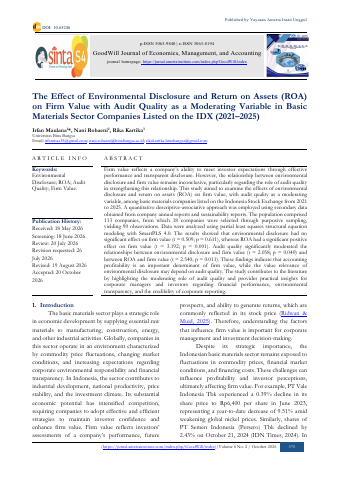
- The study covers basic materials companies on the Indonesia Stock Exchange: 18 companies selected from a population of 113, yielding 90 observations.p.1
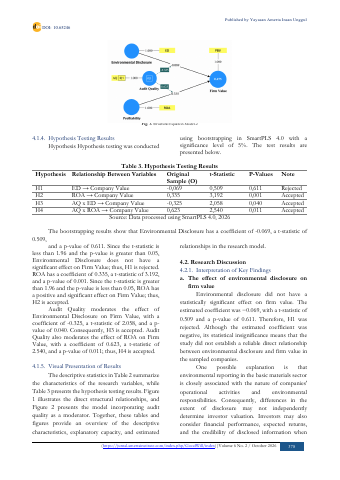
- Environmental disclosure has no significant effect on firm value (t = 0.509; p = 0.611).p.1
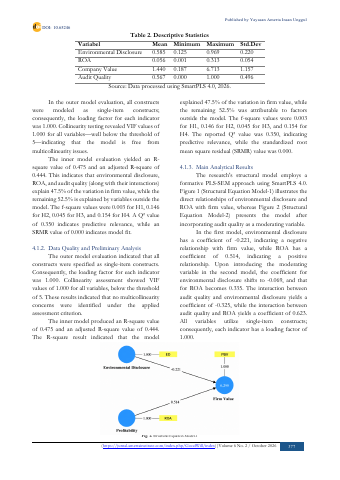
- ROA has a positive and significant effect on firm value, with a coefficient of 0.335, a t-statistic of 3.192 and a p-value of 0.001.p.9
- Audit quality moderates the effect of environmental disclosure on firm value, with a coefficient of -0.325, a t-statistic of 2.058 and a p-value of 0.040.p.9
- The interaction of audit quality and ROA has a coefficient of 0.623, a t-statistic of 2.540 and a p-value of 0.011.p.10
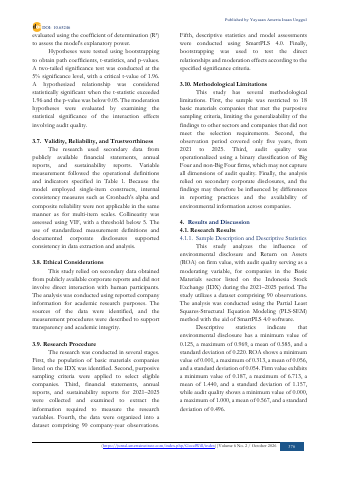
- The model explains 47.5% of the variation in firm value, with an R-square of 0.475 and an adjusted R-square of 0.444.p.8
Key insights
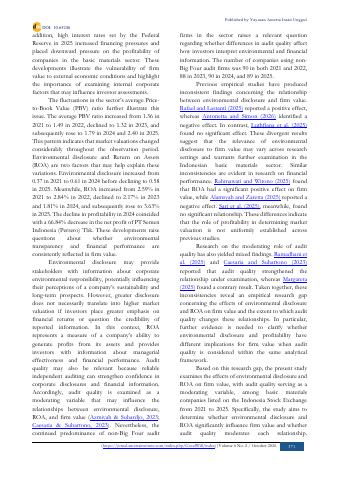
- The sector's average PBV ratio rose from 1.36 in 2021 to 1.49 in 2022, fell to 1.32 in 2023, then rose to 1.79 in 2024 and 2.40 in 2025.p.2
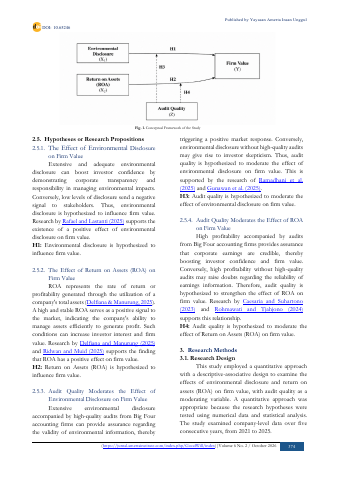
- The f-square values were 0.003 for H1, 0.146 for H2, 0.045 for H3 and 0.154 for H4.p.8
- The Q² value of 0.350 indicates predictive relevance.p.8
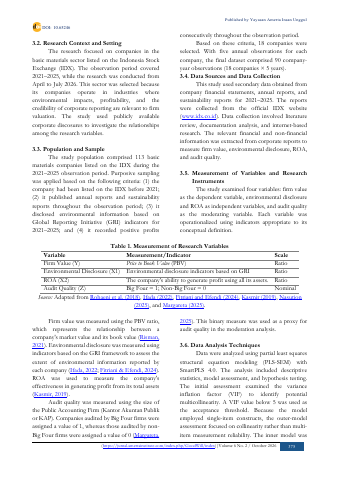
- The final dataset comprised 90 company-year observations (18 companies × 5 years).p.6
- The direction of audit-quality moderation differs: negative for environmental disclosure and positive for ROA.p.12
- Audit quality was operationalized as a binary Big Four versus non-Big Four classification, a simplified proxy.p.7
Pages
 p.1
 p.2
 p.3
 p.4
 p.5
 p.6
 p.7
 p.8
 p.9
 p.10
 p.11
 p.12
 p.13
 p.14
Topics and entities
Summary and figures generated from the document and checked automatically: every number shown appears on the cited page. Publishers can request removal.