The Application of Basic Game Theory in Financial Decision-Making (Advances in Economics Management and Political Sciences)
SaveSummary
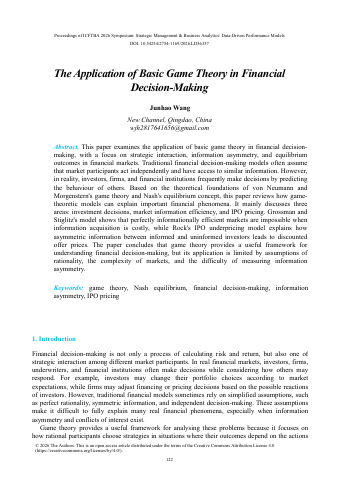
- The paper reviews how basic game theory explains strategic interaction, information asymmetry and equilibrium outcomes in financial markets.p.1
- It focuses on three areas: investment decisions, market information efficiency and IPO pricing.p.1
- Grossman and Stiglitz show that perfectly informationally efficient markets are impossible when information acquisition is costly.p.1
- Rock's model explains IPO underpricing through asymmetric information between informed and uninformed investors.p.1
- The paper concludes that game theory is useful but limited by rationality assumptions, market complexity and the difficulty of measuring information asymmetry.p.1
Key insights
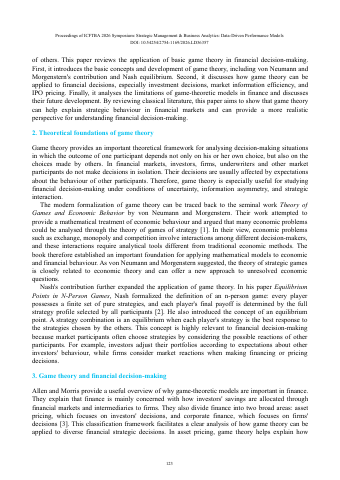
- Investors, firms and underwriters do not decide in isolation, since their choices depend on expectations about others.p.2
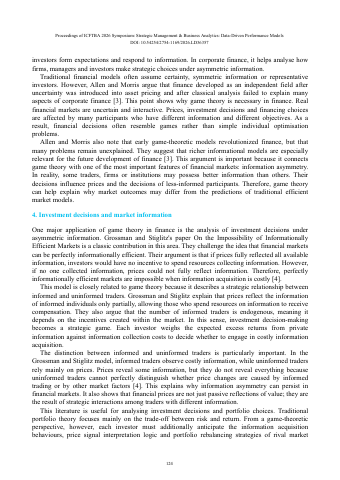
- Financial decisions often resemble games rather than simple individual optimisation problems.p.3
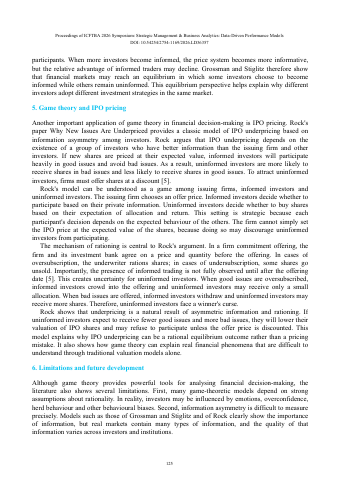
- Markets may reach an equilibrium in which some investors become informed while others stay uninformed.p.4
- To attract uninformed investors, issuing firms must offer IPO shares at a discount.p.4
- Future research may combine game theory with behavioural finance, big data and artificial intelligence.p.5
- Future models may need to consider higher-order beliefs, meaning what investors believe others know.p.5
Pages
 p.1
 p.2
 p.3
 p.4
 p.5
 p.6
Topics and entities
Summary and figures generated from the document and checked automatically: every number shown appears on the cited page. Publishers can request removal.