Supply-Chain Concentration, Debt Covenants and Accounting Conservatism: Evidence from Financing Constraints and Asset Allocation Adjustment (Advances in Economics Management and Political Sciences)
SaveWhat changed
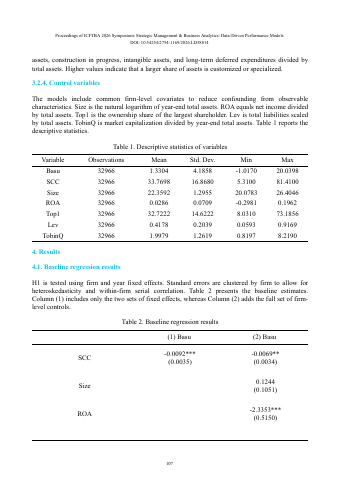
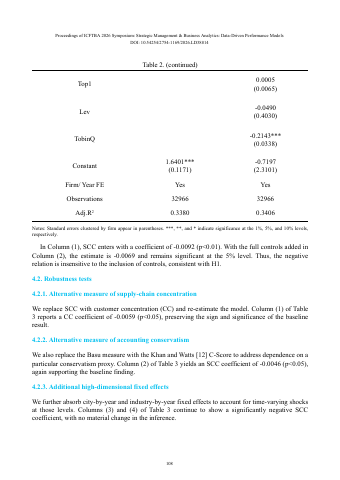
-0.0069 coefficient
SCC coefficient on accounting conservatism (Basu) with full controls p.6
Summary
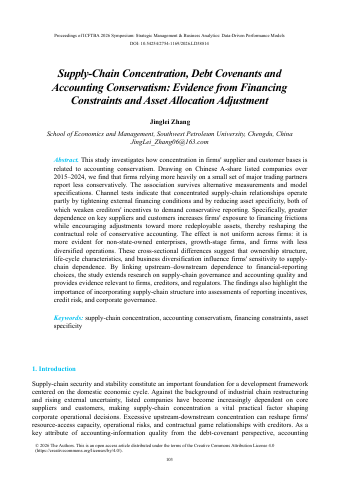
- Using Chinese A-share listed companies over 2015–2024, the study finds that firms relying more on a small set of major trading partners report less conservatively.p.1
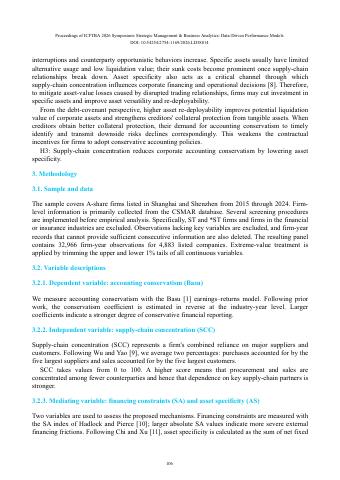
- The analysis uses 32,966 firm-year observations.p.10
- In the baseline regression, the supply-chain concentration (SCC) coefficient is -0.0092 (p<0.01), and -0.0069 with full controls, significant at the 5% level.p.6
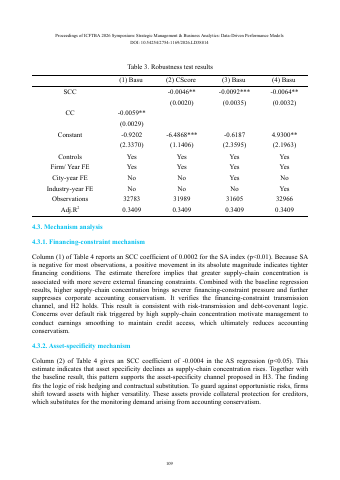
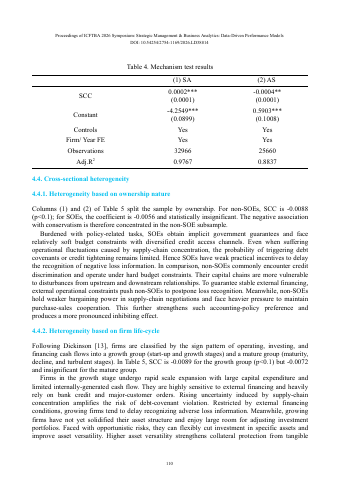
- The financing-constraint channel shows an SCC coefficient of 0.0002 on the SA index (p<0.01), and the asset-specificity channel an SCC coefficient of -0.0004 (p<0.05).p.7
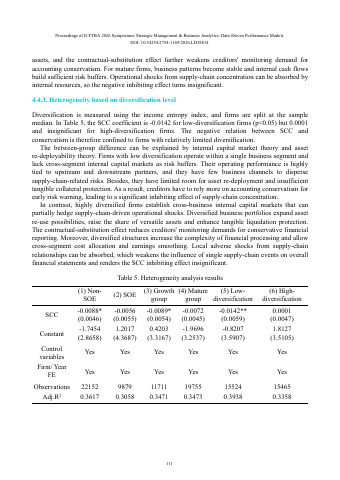
- The effect is concentrated in non-state-owned enterprises, with an SCC coefficient of -0.0088 against -0.0056 and insignificant for state-owned enterprises.p.8
- For low-diversification firms the SCC coefficient is -0.0142 (p<0.05), while for high-diversification firms it is 0.0001 and insignificant.p.9
Key insights
- Higher supply-chain concentration is associated with less conservative reporting, and the result persists with alternative measures and richer fixed effects.p.10
- Replacing SCC with customer concentration gives a coefficient of -0.0059 (p<0.05), preserving the baseline sign and significance.p.6
- Using the Khan and Watts C-Score as the conservatism measure gives an SCC coefficient of -0.0046 (p<0.05).p.6
- Greater supply-chain concentration is associated with more severe external financing constraints, which further suppresses conservatism.p.7
- Higher concentration is associated with lower asset specificity, so firms shift toward more redeployable assets and creditors demand less conservatism.p.7
- State-owned enterprises face softer budget constraints, so the negative association is weak for them.p.8
- Low-diversification firms lack internal capital markets as risk buffers, so creditors rely more on conservatism for early risk warning.p.9
Pages
 p.1
 p.2
 p.3
 p.4
 p.5
 p.6
 p.7
 p.8
 p.9
 p.10
Funders mentioned
Topics and entities
Summary and figures generated from the document and checked automatically: every number shown appears on the cited page. Publishers can request removal.