Study on IPO Underpricing and Long-Run Aftermarket Performance in Hong Kong (International Journal of Business & Management Studies)
Summary
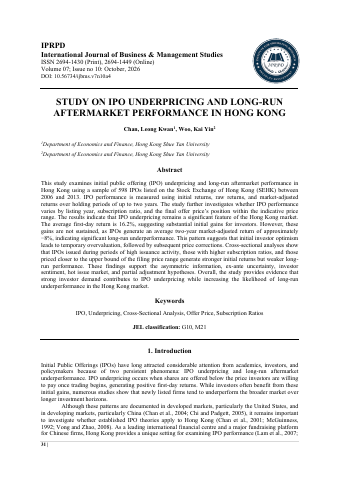
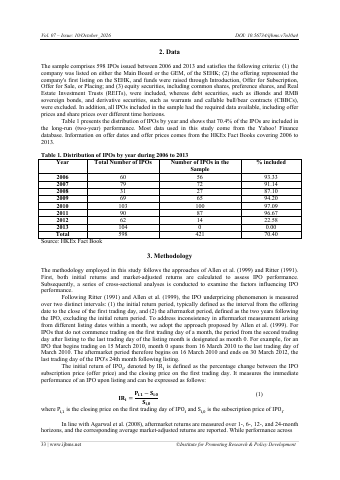
- The study analyzes a sample of 598 IPOs listed on the Stock Exchange of Hong Kong (SEHK) between 2006 and 2013.p.1
- IPOs in Hong Kong generated an average first-day initial return of 16.2%, demonstrating persistent short-run underpricing.p.1
- Over a two-year aftermarket period, IPOs produced an average market-adjusted return of approximately −8%, indicating significant long-run underperformance.p.1
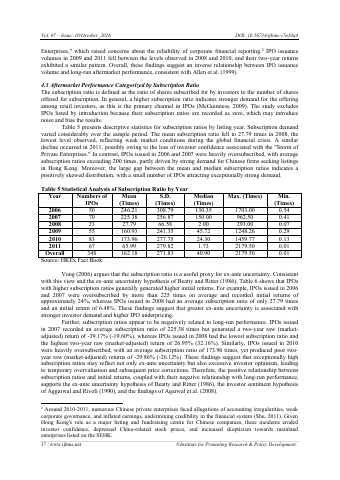
- IPOs oversubscribed by over 225 times in 2006 and 2007 achieved initial returns of approximately 24%.p.7
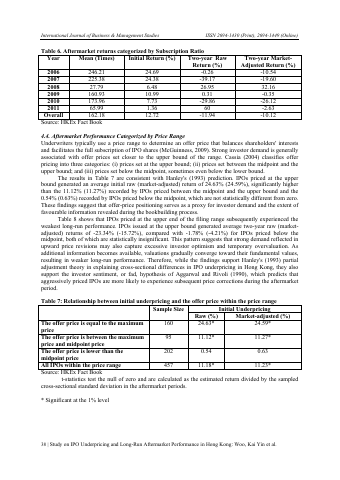
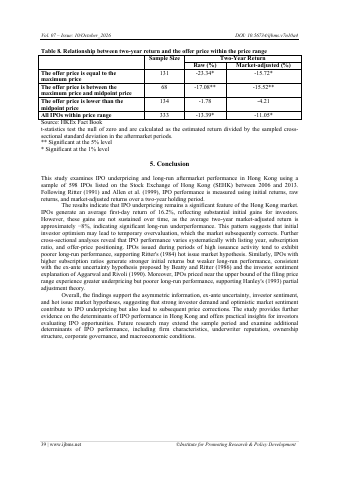
- Offer prices set at the maximum of the indicative filing price range recorded an average initial market-adjusted return of 24.59%.p.8
Key insights
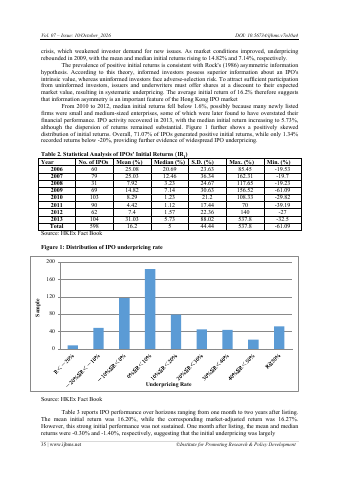
- Across the entire sample, 71.07% of the analyzed IPOs yielded positive initial returns.p.5
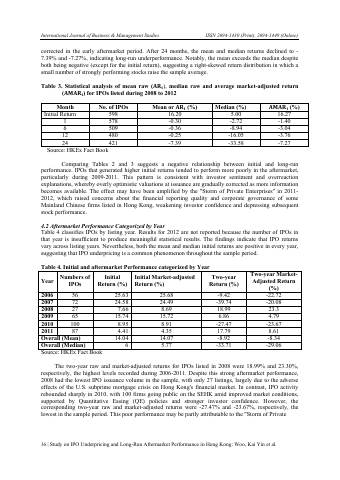
- Initial performance was largely corrected in the early aftermarket, with mean raw returns falling to -0.30% after one month.p.5
- IPOs issued during 2008 recorded the highest two-year market-adjusted return of 23.30%, despite corresponding to the lowest issuance volume of 27 listings.p.6
- In contrast, IPO issuance peaked in 2010 with 100 listings but delivered the lowest two-year market-adjusted return of -23.67%.p.6
- IPOs priced at the maximum price range exhibited an initial raw return of 24.63%, compared to 0.54% for IPOs priced lower than the midpoint.p.8
- IPOs set at the maximum price range suffered the weakest long-run performance, recording an average two-year raw return of -23.34%.p.9
Pages
 p.1
 p.2
 p.3
 p.4
 p.5
 p.6
 p.7
 p.8
 p.9
 p.10
Topics and entities
Summary and figures generated from the document and checked automatically: every number shown appears on the cited page. Publishers can request removal.