Problems of Developing the Securities Market in the Region: A Case Study of Uzbekistan (American Journal of Economics and Business Management)
SaveSummary
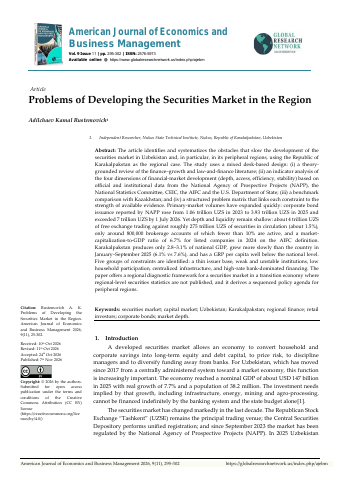
- Corporate bond issuance reported by NAPP rose from 1.06 trillion UZS in 2023 to 3.93 trillion UZS in 2025.p.1
- Free exchange trading is about 4 trillion UZS against roughly 275 trillion UZS of securities in circulation (about 1.5%).p.1
- There are only around 800,000 brokerage accounts, of which fewer than 10% are active.p.1
- The market-capitalization-to-GDP ratio for listed companies was 6.7% in 2024 on the AIFC definition.p.1
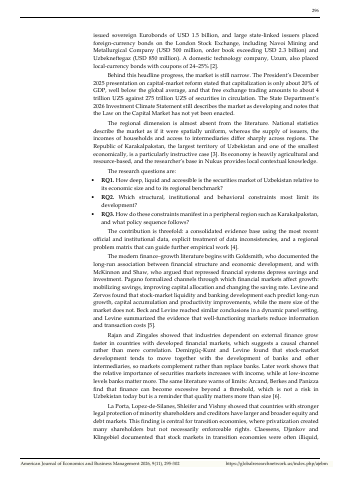
- Large state-linked issuers placed foreign-currency bonds in London, including Navoi Mining and Metallurgical Company (USD 500 million) and Uzbekneftegaz (USD 850 million), alongside sovereign Eurobonds of USD 1.5 billion.p.2
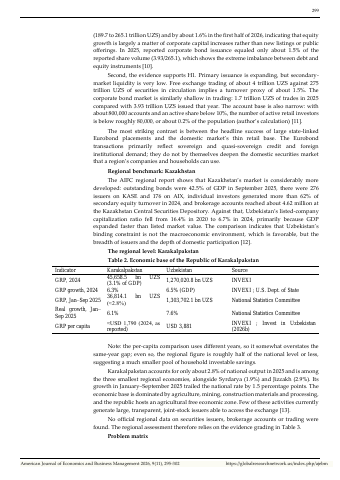
- Kazakhstan's market is considerably more developed: outstanding bonds were 42.5% of GDP in September 2025, with 276 issuers on KASE and 176 on AIX.p.5
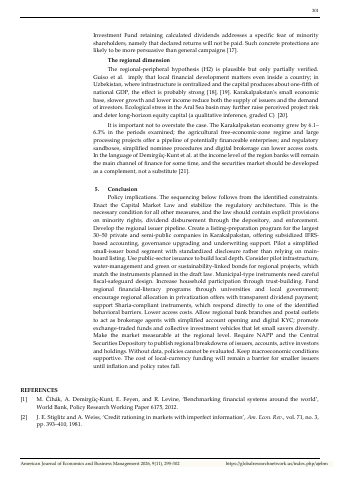
- The Karakalpakstan economy grew by 6.1–6.3% in the periods examined, but the study argues banks will remain the main channel of finance for some time.p.7
Key insights
- Domestic placements are also expanding, with Uzum placing local-currency bonds at coupons of 24–25%.p.2
- A December 2025 presidential presentation stated that capitalization is only about 20% of GDP.p.2
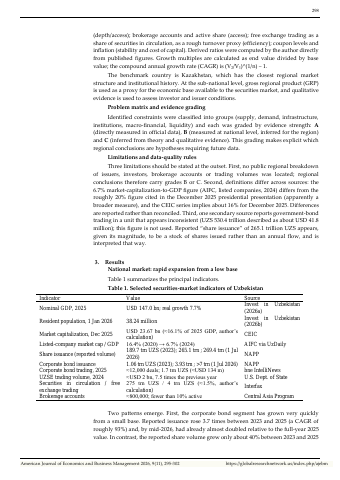
- Market-capitalization-to-GDP figures differ by source: 6.7% (AIFC, 2024), roughly 20% (presidential presentation) and about 16% implied by CEIC.p.4
- In 2025, reported corporate bond issuance equaled only about 1.5% of the reported share volume (3.93/265.1), showing a strong imbalance between debt and equity instruments.p.5
- Corporate bond trades were 1.7 trillion UZS in 2025 compared with 3.93 trillion UZS issued that year, showing shallow secondary trading.p.5
- With about 800,000 accounts and an active share below 10%, active retail investors are below roughly 80,000, or about 0.2% of the population (author's calculation).p.5
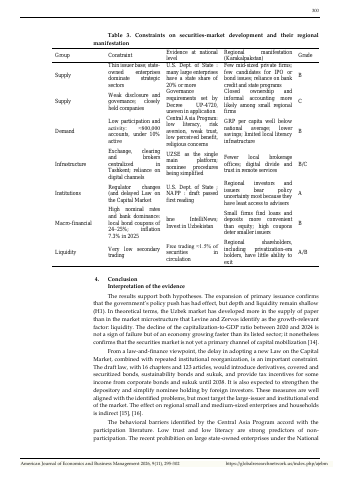
- High nominal rates weigh on smaller issuers: local bond coupons are 24–25% and inflation was 7.3% in 2025.p.6
- Large Eurobond placements reflect sovereign and quasi-sovereign credit and foreign demand and do not by themselves deepen the domestic securities market.p.5
Pages
 p.1
 p.2
 p.3
 p.4
 p.5
 p.6
 p.7
 p.8
Funders mentioned
Topics and entities
Summary and figures generated from the document and checked automatically: every number shown appears on the cited page. Publishers can request removal.