Green rules, safer banks? ESG and bank risk in Brazil (Brazilian Review of Finance)
SaveSummary
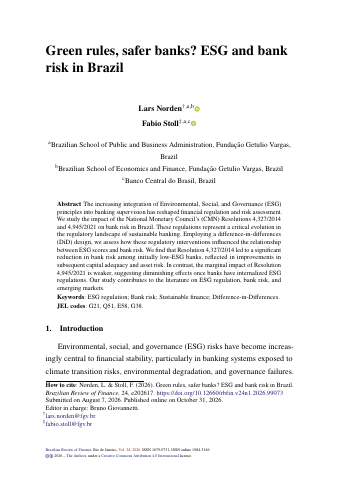
- The study examines the National Monetary Council's Resolutions 4,327/2014 and 4,945/2021 using a difference-in-differences design.p.1
- Resolution 4,327/2014 led to a significant reduction in bank risk among initially low-ESG banks, while the effect of Resolution 4,945/2021 is weaker.p.1
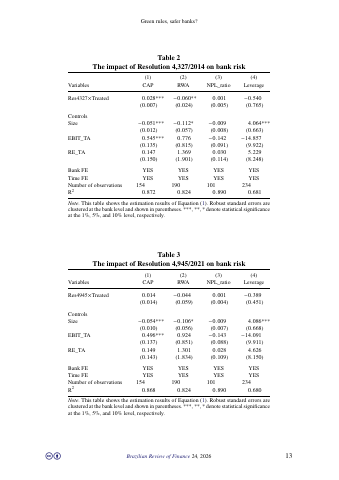
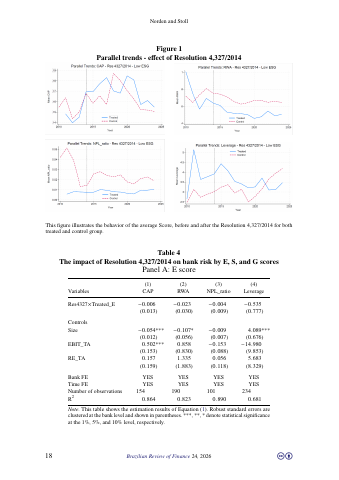
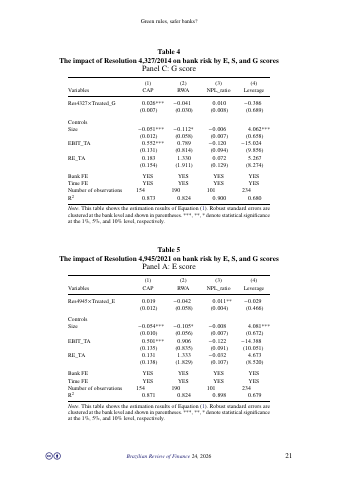
- For Resolution 4,327/2014, the capital adequacy coefficient for treated banks is 0.028.p.13
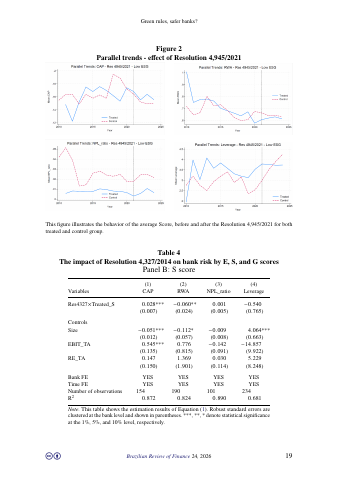
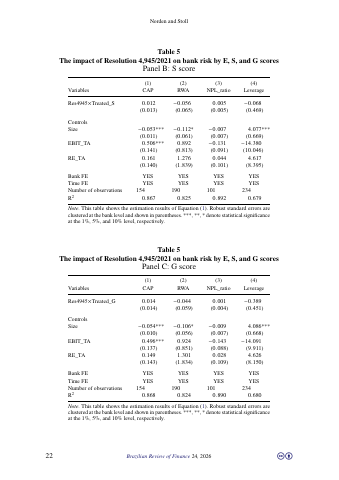
- For Resolution 4,945/2021, the capital adequacy coefficient is 0.014 and not statistically significant.p.13
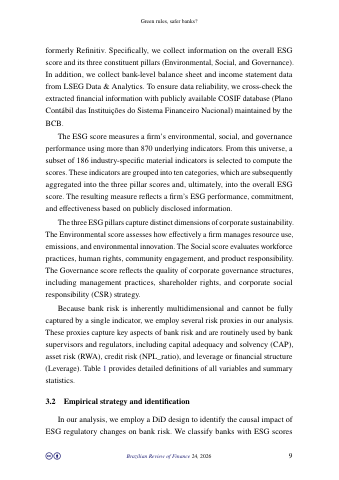
- ESG scores use more than 870 indicators, of which 186 industry-specific indicators are selected.p.9
- The analysis covers the Brazilian banking sector between 2010 and 2024.p.24
Key insights
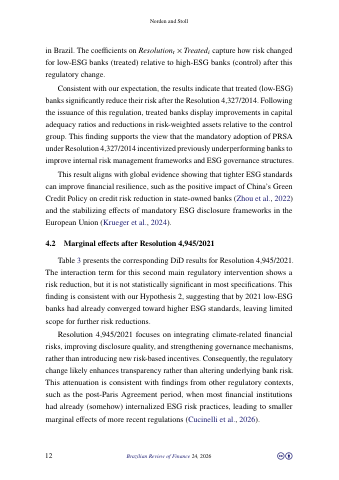
- Low-ESG banks improved capital adequacy and asset risk after the first resolution.p.1
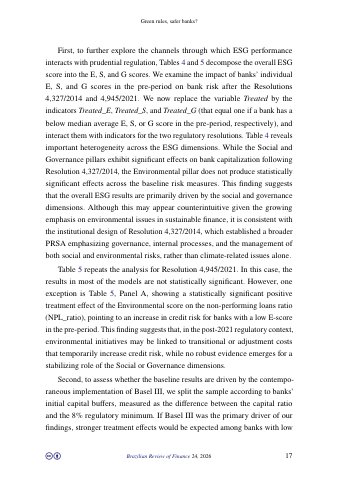
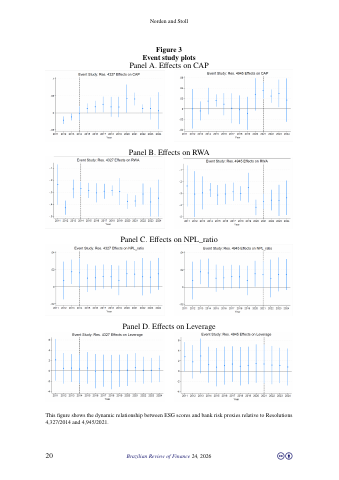
- Effects of the first resolution are driven mainly by the social and governance pillars, not the environmental pillar.p.17
- The later resolution produced no additional convergence in bank risk between low-ESG and high-ESG banks.p.15
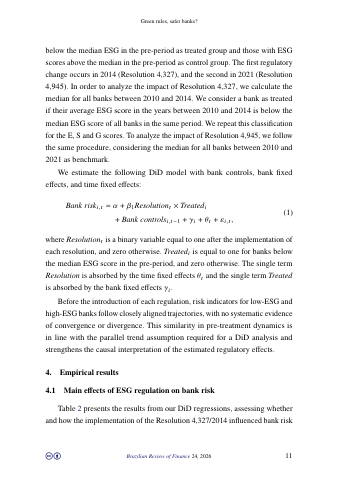
- Treated banks show improved capital adequacy ratios and lower risk-weighted assets relative to control banks.p.12
- Results suggest ESG regulation can act as a convergence mechanism when it is a binding shock.p.4
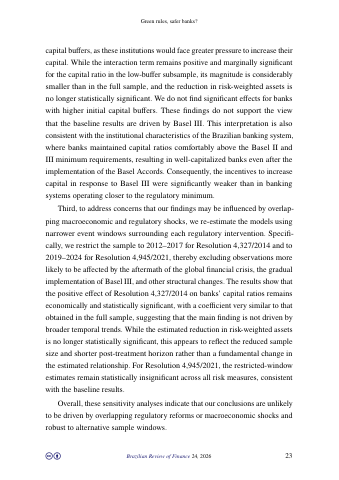
- Banks maintained capital ratios comfortably above Basel II and III minimum requirements.p.23
Pages
 p.1
 p.2
 p.3
 p.4
 p.5
 p.6
 p.7
 p.8
 p.9
 p.10
 p.11
 p.12
 p.13
 p.14
 p.15
 p.16
 p.17
 p.18
 p.19
 p.20
 p.21
 p.22
 p.23
 p.24
 p.25
 p.26
 p.27
 p.28
 p.29
Funders mentioned
Topics and entities
Summary and figures generated from the document and checked automatically: every number shown appears on the cited page. Publishers can request removal.