Governing Wildfire Insurance Under Mortgage Constraints: An Availability-Affordability-Capacity Framework with Decision-Oriented Evaluation for California, 2018-2024 (Research Square)
SaveSummary
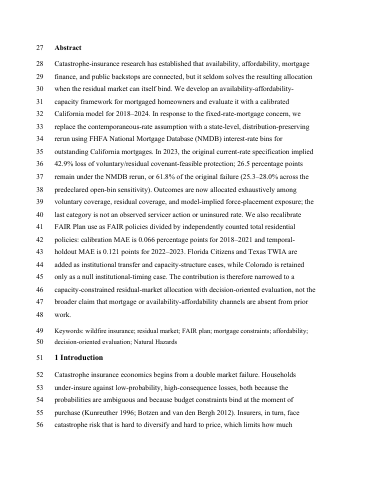
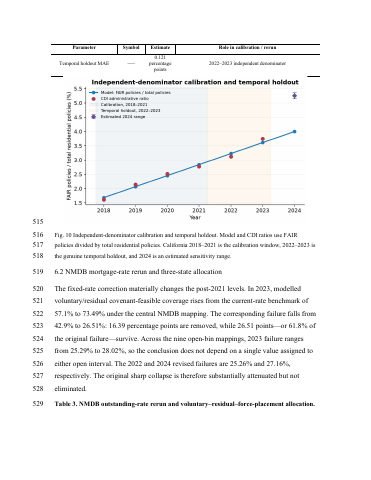
- FAIR Plan calibration MAE is 0.066 percentage points for 2018-2021 and temporal-holdout MAE is 0.121 points for 2022-2023.p.3
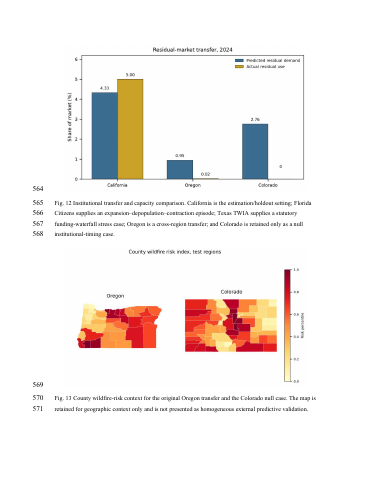
- California FAIR Plan share of residential policies rose from 1.617% in 2018 to 3.749% in 2023, with an estimated 2024 share of 5.15-5.36%.p.18
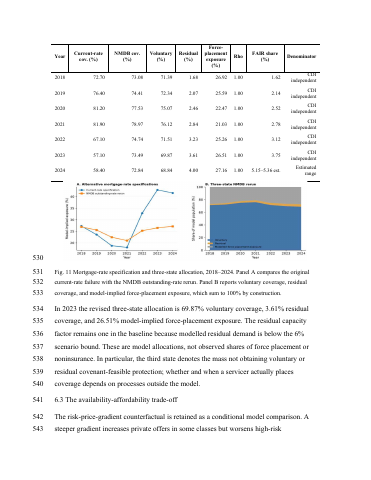
- The revised 2023 allocation is 69.87% voluntary coverage, 3.61% residual coverage and 26.51% model-implied force-placement exposure.p.25
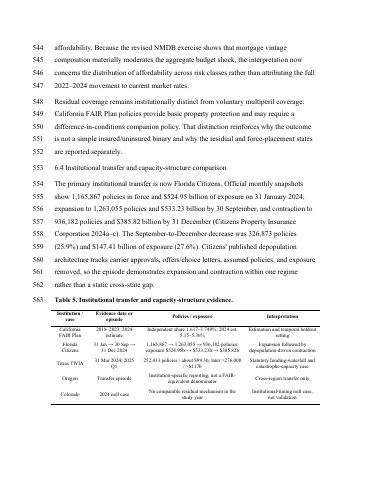
- Florida Citizens policies fell from 1,263,055 to 936,182 between 30 September and 31 December, a decrease of 326,873 policies (25.9%).p.26
- Texas TWIA reported 252,433 policies in force and approximately $99.3 billion of exposure at 31 March 2024.p.28
Key insights
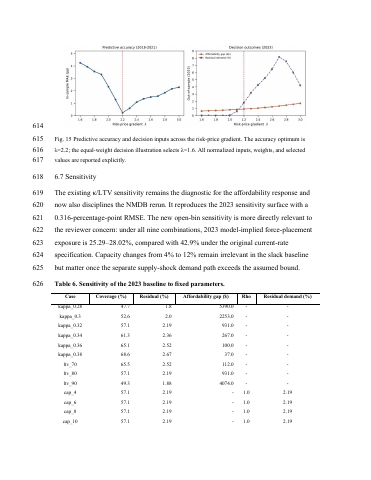
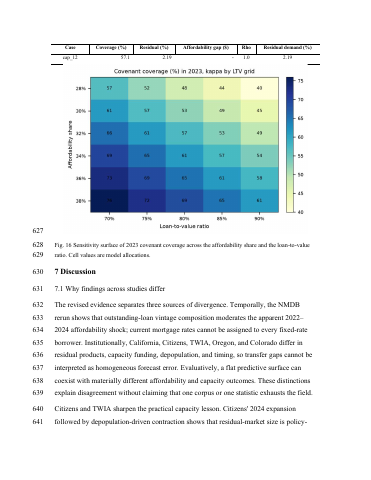
- Across nine open-bin mappings, 2023 failure ranges from 25.29% to 28.02%, so the result does not depend on a single assumed value.p.24
- The revised failure is 25.26% in 2022 and 27.16% in 2024, so the original sharp collapse is attenuated but not eliminated.p.24
- Model-implied force-placement exposure is not an observed servicer action or uninsured rate.p.25
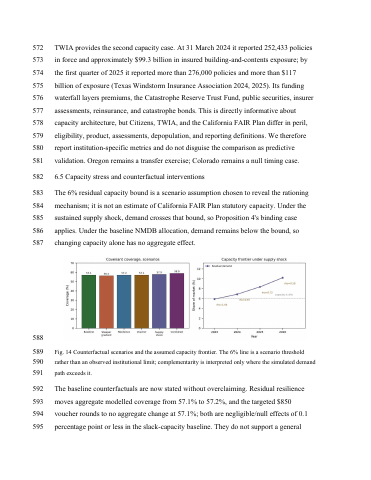
- The 6% residual capacity bound is a scenario assumption and not an estimate of California FAIR Plan statutory capacity.p.28
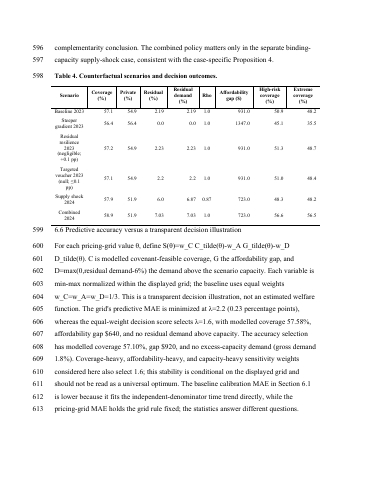
- Residual resilience moves aggregate modelled coverage only from 57.1% to 57.2%.p.28
- Predictive MAE is minimized at λ=2.2, whereas the equal-weight decision score selects λ=1.6.p.29
- Under all nine open-bin combinations, 2023 force-placement exposure is 25.29-28.02%, compared with 42.9% under the original specification.p.30
Pages
 p.1
 p.2
 p.3
 p.4
 p.5
 p.6
 p.7
 p.8
 p.9
 p.10
 p.11
 p.12
 p.13
 p.14
 p.15
 p.16
 p.17
 p.18
 p.19
 p.20
 p.21
 p.22
 p.23
 p.24
 p.25
 p.26
 p.27
 p.28
 p.29
 p.30
 p.31
 p.32
 p.33
 p.34
 p.35
 p.36
 p.37
 p.38
 p.39
Funders mentioned
Topics and entities
Summary and figures generated from the document and checked automatically: every number shown appears on the cited page. Publishers can request removal.