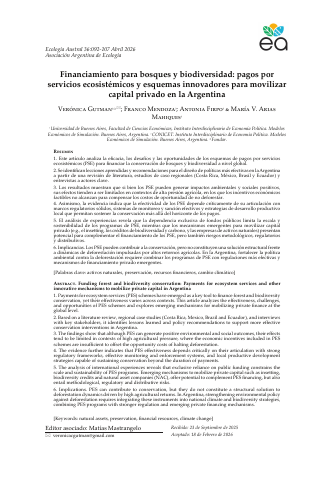
Financing for Forests and Biodiversity: Payments for Ecosystem Services and Innovative Schemes to Mobilize Private Capital in Argentina (Ecología Austral)
Summary
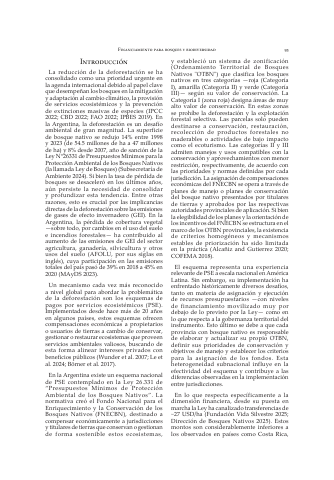
- Argentina lost 14% of its native forest area between 1998 and 2023, declining from 54.5 million ha to 47 million ha.p.2
- Emissions from Argentina's AFOLU sector increased their share of national greenhouse gas emissions from 39% in 2018 to 45% in 2020.p.2
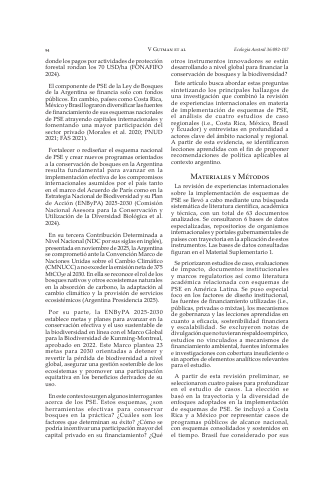
- Under its third NDC, Argentina committed to capping net greenhouse gas emissions at 375 MtCO₂e by 2030.p.3
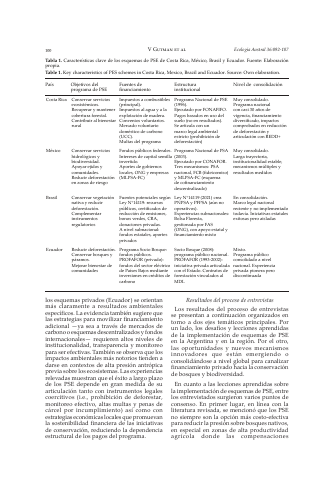
- Costa Rica's PES scheme has protected approximately 800000 ha (nearly 15% of national territory), paying 72.1 USD/ha for protection in 2023.p.6
- Mexico's national PSA program covers 1.63 million ha, accounting for 2.5% of the nation's forests and woodlands.p.7
- Brazil's subnational Bolsa Floresta Program received ~$21 million from 2008 to 2021, covering over 10 million ha across 9600 households.p.8
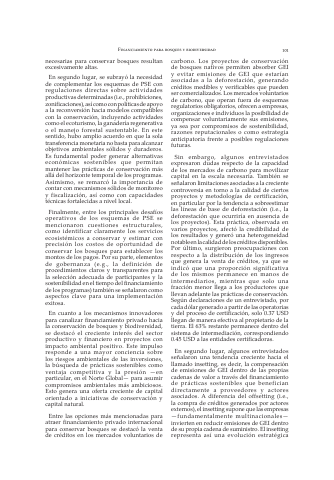
- Intermediary fees in voluntary carbon credit operations leave only 0.37 USD per dollar generated for the actual landholder.p.10
Key insights
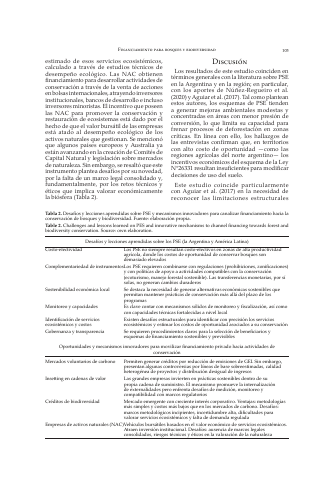
- Exclusive reliance on public funds constrains the scalability and long-term financial stability of PES schemes.p.1
- PES financial incentives often fail to prevent deforestation in agricultural expansion zones where land opportunity costs are high.p.1
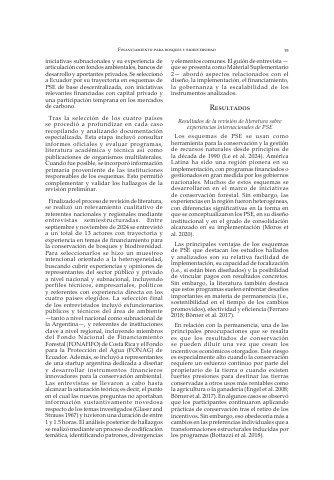
- Long-term conservation success requires pairing PES incentives with strong regulatory enforcement and productive local development.p.4
- Costa Rica successfully diversified PES funding by combining fuel and water tariffs with domestic voluntary carbon units.p.6
- Mexico uses a seed-capital endowment trust fund (FCB) to generate annual financial returns for funding long-term conservation contracts.p.7
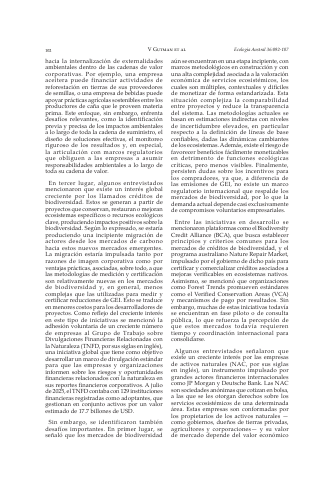
- Overestimating baseline deforestation in voluntary carbon markets has damaged project credibility and skewed credit quality.p.10
- Corporate insetting allows companies to internalize environmental obligations by funding sustainability directly within their own supply chains.p.10
- Natural Asset Companies (NACs) aim to convert ecosystem performance into market capitalization, attracting public stock market equity to conservation.p.12
Pages
 p.1
 p.2
 p.3
 p.4
 p.5
 p.6
 p.7
 p.8
 p.9
 p.10
 p.11
 p.12
 p.13
 p.14
 p.15
 p.16
Topics and entities
Summary and figures generated from the document and checked automatically: every number shown appears on the cited page. Publishers can request removal.