Digital Marketing and Inclusive Finance: A Mechanism Analysis from the Perspectives of Cost Optimization, Efficiency Enhancement, and Resource Allocation (Advances in Economics Management and Political Sciences)
SaveKey number
63%
Share of the FinTech effect on financial inclusion from digital marketing customer acquisition p.4
Summary
- Inclusive finance has been limited by information asymmetry, insufficient branch coverage and the "80/20 rule" mindset, leaving long-tail customers underserved.p.1
- Digital marketing reduces information asymmetry, extends service reach and improves resource allocation.p.1
- High initial customer acquisition cost (CAC) and weak business sustainability remain significant limits of the model.p.1
- Digital marketing changes the cost structure of financial services through information cost, expansion cost and customer acquisition cost.p.4
- According to Rehman et al., the customer acquisition effect of digital marketing accounts for about 63% of the overall FinTech effect on financial inclusion.p.4
Key insights
- Digital marketing is applicable to the front end of the financial value chain and focuses on reaching more customers.p.2
- Digital marketing can reduce information asymmetry and matching costs, making financial resources more accessible to the long tail.p.3
- Digital channels let firms reach distant customers at a marginal cost close to zero.p.4
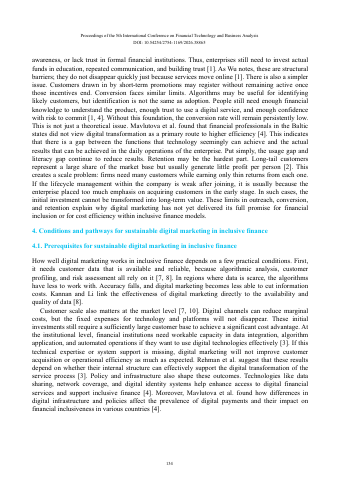
- Low financial literacy and weak trust mean firms still need to invest in education and trust building.p.5
- Long-tail customers represent a large share of the market base but usually generate little profit per person.p.5
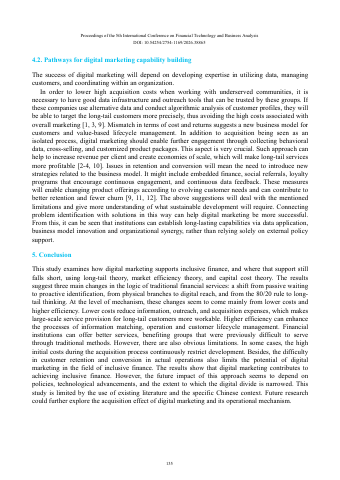
- Embedded finance, social referrals and loyalty programs can improve retention and reduce churn.p.6
Pages
 p.1
 p.2
 p.3
 p.4
 p.5
 p.6
 p.7
Topics and entities
Summary and figures generated from the document and checked automatically: every number shown appears on the cited page. Publishers can request removal.