Cryptocurrency Validation and Energy Transition in West Africa: A Comparative Analysis of PoW and PoS (International Journal of Energy Economics and Policy)
Summary
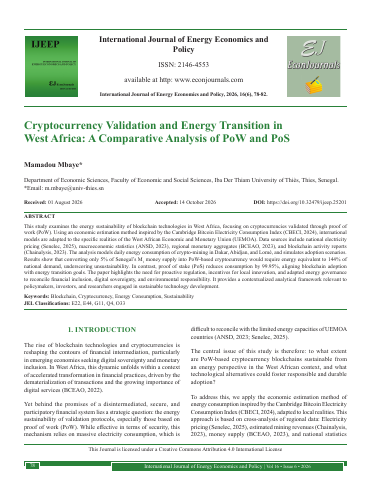
- Converting 5% of Senegal's M1 money supply into PoW-based cryptocurrency would require energy equivalent to 144% of daily national demand.p.1
- Adopting Proof of Stake (PoS) reduces blockchain energy consumption by 99.95% compared to Proof of Work (PoW).p.2
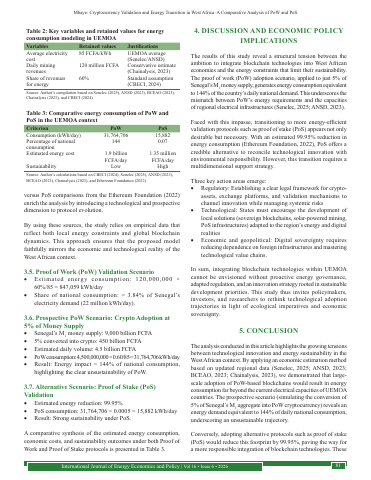
- Baseline estimated PoW energy consumption is 847,059 kWh/day, representing 3.84% of Senegal's daily electricity demand of 22 million kWh/day.p.4
- Senegal's M1 money supply totals 9,000 billion FCFA, with a 5% conversion scenario equating to 450 billion FCFA.p.4
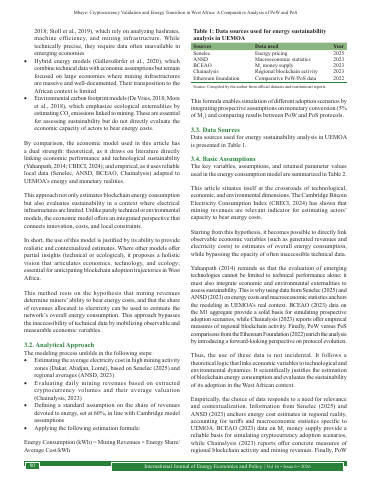
- The model uses an average UEMOA electricity price of 85 FCFA/kWh and assumes miners spend 60% of revenues on energy.p.4
- Under the 5% conversion scenario, daily energy costs are estimated at 1.9 billion FCFA/day for PoW versus 1.35 million FCFA/day for PoS.p.4
Key insights
- Converting just 5% of Senegal's M1 money supply into PoW cryptocurrency would demand 144% of the country's daily electricity capacity.p.1
- Transitioning to a PoS consensus mechanism cuts energy usage by 99.95%, making blockchain adoption compatible with energy constraints.p.2
- Baseline PoW mining operations account for 3.84% of Senegal's total daily electricity demand of 22 million kWh/day.p.4
- Daily PoW energy costs under a 5% adoption scenario reach 1.9 billion FCFA/day compared to only 1.35 million FCFA/day for PoS.p.4
- Regional adoption modeling is based on Senegal's M1 money supply of 9,000 billion FCFA.p.4
- Sustainable adoption requires proactive regulation, incentives for local green mining, and aligned energy governance.p.5
Pages
 p.1
 p.2
 p.3
 p.4
 p.5
Topics and entities
Summary and figures generated from the document and checked automatically: every number shown appears on the cited page. Publishers can request removal.