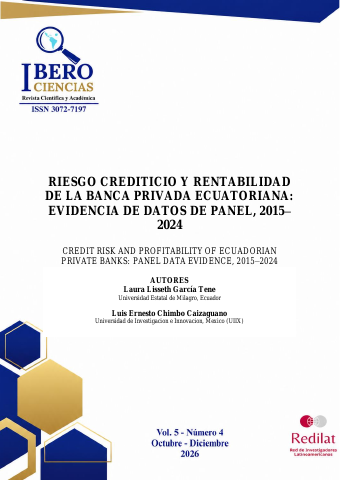
Credit Risk and Profitability of Ecuadorian Private Banks: Panel Data Evidence, 2015-2024 (Ibero Ciencias - Revista Científica y Académica)
SaveSummary
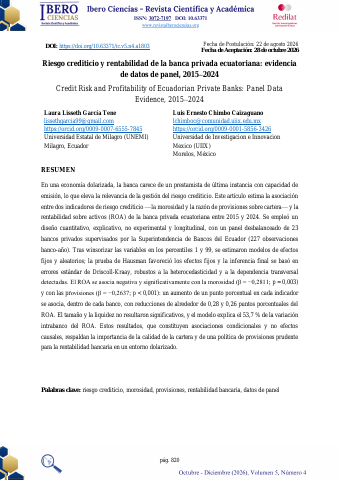
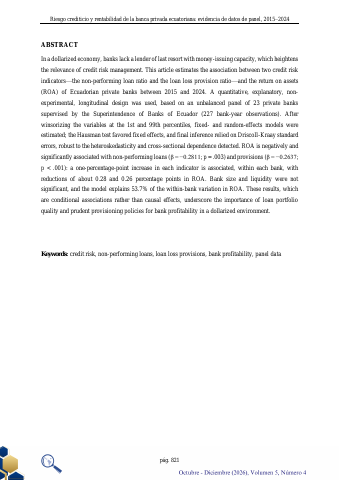
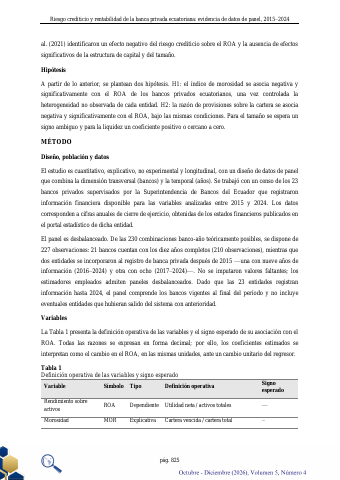
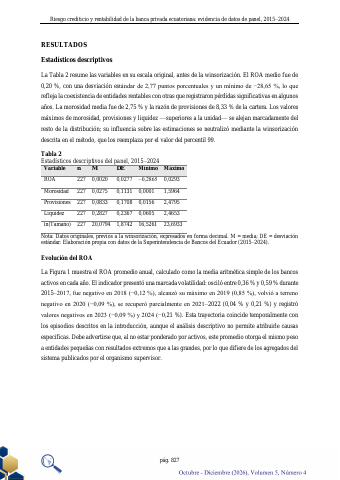
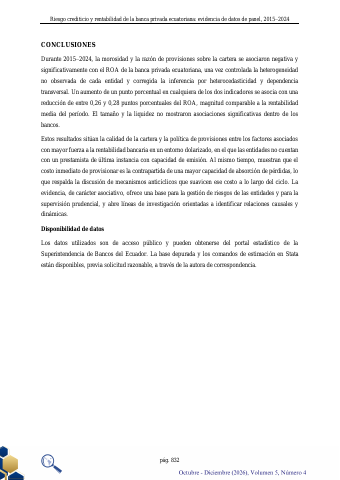
- The study uses an unbalanced panel of 23 private banks supervised by the Superintendence of Banks of Ecuador (227 bank-year observations) between 2015 and 2024.p.3
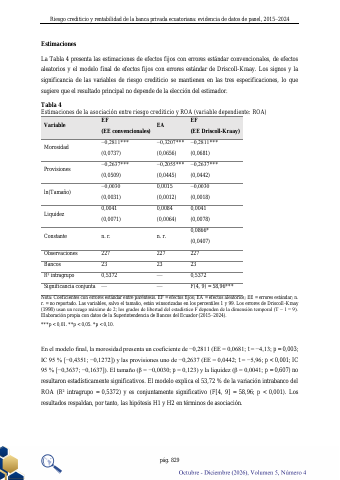
- ROA is negatively and significantly associated with non-performing loans (beta = -0.2811; p = .003).p.3
- ROA is also negatively associated with provisions (beta = -0.2637; p < .001).p.3
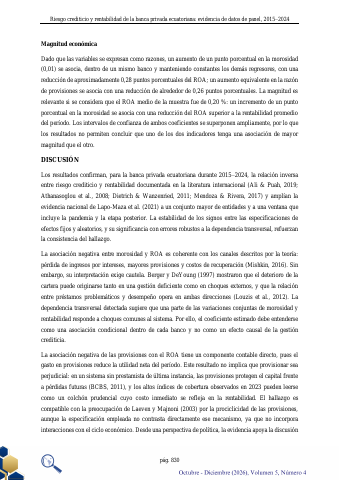
- A one-percentage-point increase in each indicator is associated with ROA reductions of about 0.28 and 0.26 percentage points within each bank.p.3
- The model explains 53.7% of the within-bank variation in ROA.p.3
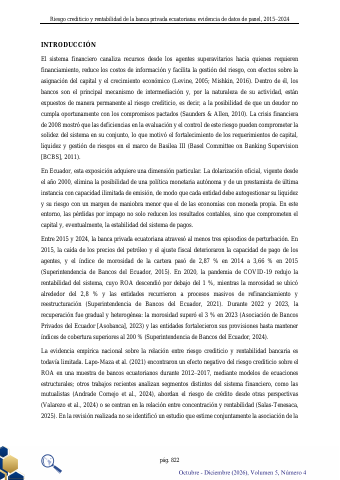
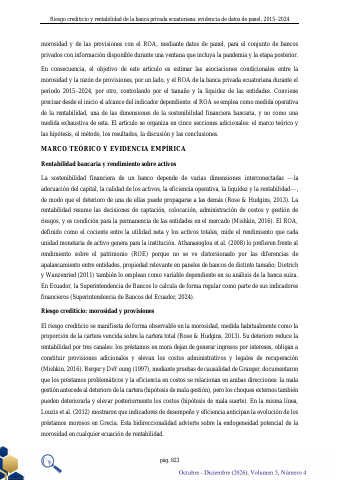
- Official dollarization, in force since 2000, removes autonomous monetary policy and a lender of last resort with unlimited issuing capacity.p.4
Key insights
- Bank size and liquidity were not significant in the model.p.3
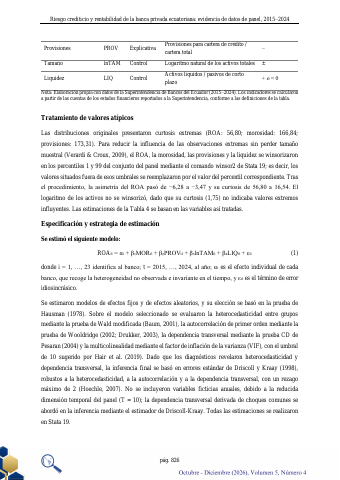
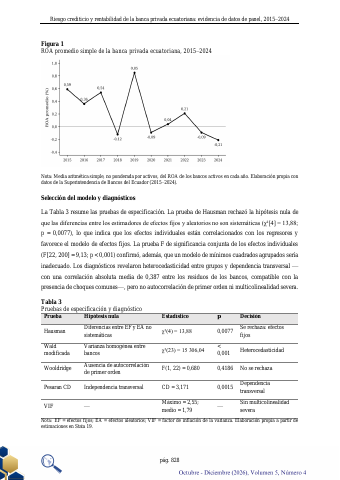
- The Hausman test favored fixed effects, and final inference used Driscoll-Kraay standard errors robust to heteroskedasticity and cross-sectional dependence.p.3
- The results are conditional associations rather than causal effects.p.3
- Variables were winsorized at the 1st and 99th percentiles before estimation.p.3
- The signs and significance of the credit risk variables hold across the three model specifications.p.11
- The confidence intervals of the two coefficients overlap widely, so neither indicator can be said to have a larger association with ROA.p.12
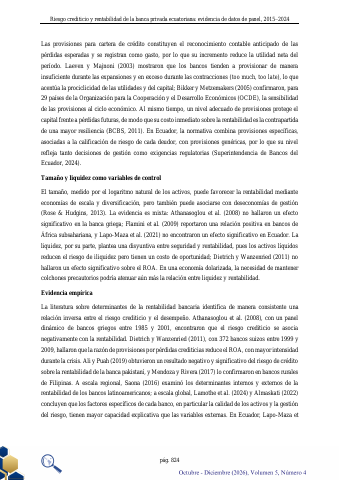
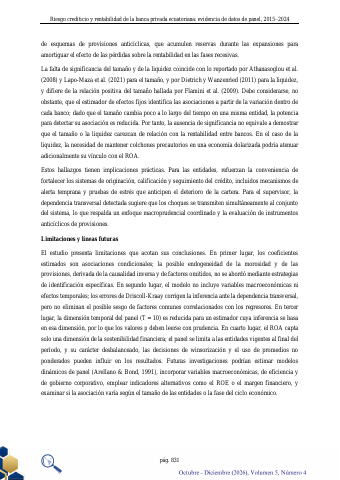
- The authors recommend evaluating countercyclical provisioning schemes that build reserves during expansions.p.13
Pages
 p.1
 p.2
 p.3
 p.4
 p.5
 p.6
 p.7
 p.8
 p.9
 p.10
 p.11
 p.12
 p.13
 p.14
 p.15
 p.16
 p.17
Funders mentioned
Topics and entities
Summary and figures generated from the document and checked automatically: every number shown appears on the cited page. Publishers can request removal.