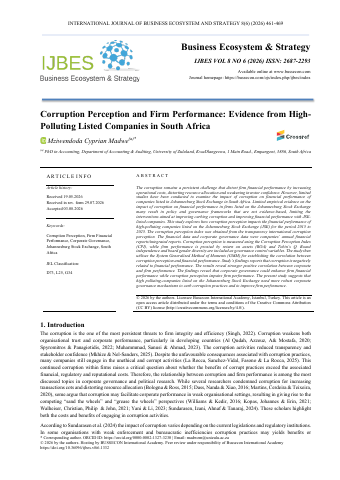
Corruption Perception and Firm Performance: Evidence from High-Polluting Listed Companies in South Africa (International Journal of Business Ecosystem and Strategy (2687-2293))
SaveSummary
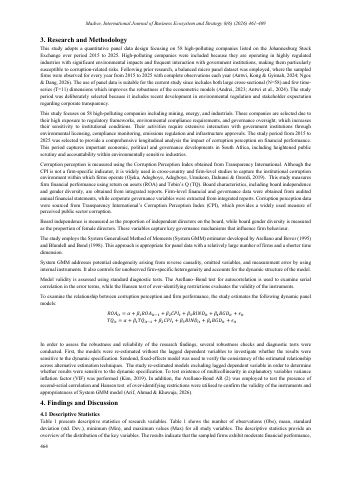
- The study uses a balanced panel of 58 high-polluting JSE-listed companies from 2015 to 2025.p.4
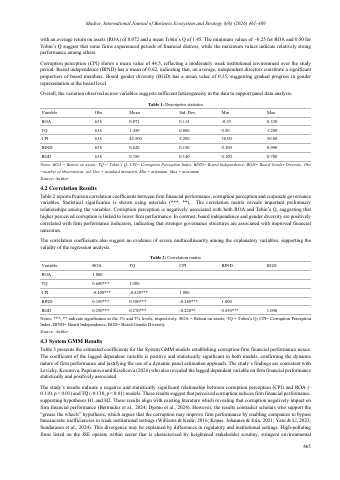
- The mean Corruption Perception Index is 44.5, reflecting a moderately weak institutional environment.p.5
- Board independence has a mean of 0.62 and board gender diversity a mean of 0.35.p.5
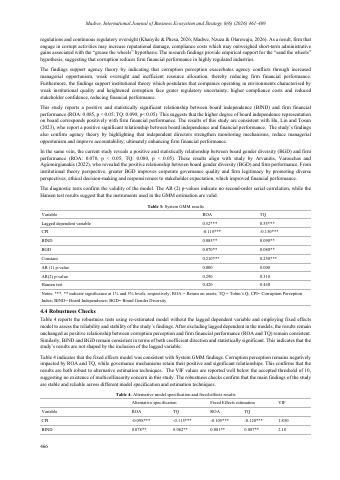
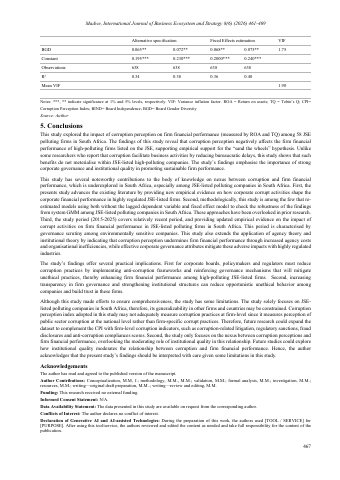
- Board independence is positively and significantly related to performance (ROA: 0.085; TQ: 0.090).p.6
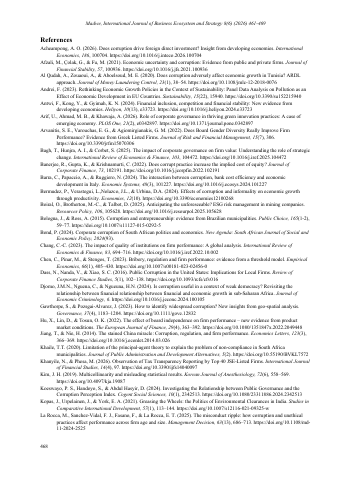
- Corruption perception negatively affects the financial performance of the 58 JSE high-polluting firms, supporting the sand-the-wheels hypothesis.p.7
Key insights
- The panel has a cross-section of N=58 and a time dimension of T=11.p.4
- Minimum values of -0.25 for ROA and 0.50 for Tobin's Q suggest some firms experienced periods of financial distress.p.5
- Findings support the sand-the-wheels hypothesis, as corruption reduces firm financial performance in highly regulated industries.p.6
- Findings support agency theory, as corruption perception exacerbates managerial opportunism and weak oversight.p.6
- Independent directors strengthen monitoring, consistent with agency theory.p.6
- Benefits of corruption seen in weak-regulation settings do not materialise in JSE-listed high-polluting companies.p.7
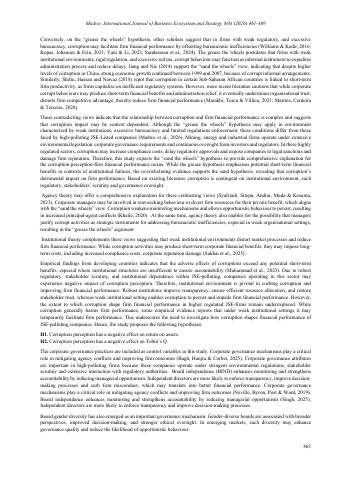
- Prior work on China cites strong economic growth continuing between 1999 and 2007 despite high corruption, supporting a grease-the-wheels view.p.3
Pages
 p.1
 p.2
 p.3
 p.4
 p.5
 p.6
 p.7
 p.8
 p.9
Funders mentioned
Topics and entities
Summary and figures generated from the document and checked automatically: every number shown appears on the cited page. Publishers can request removal.