Bank-Specific Determinants of Profitability: Evidence from Nepalese Commercial Banks (Morgan Journal of Interdisciplinary Research Studies)
SaveSummary
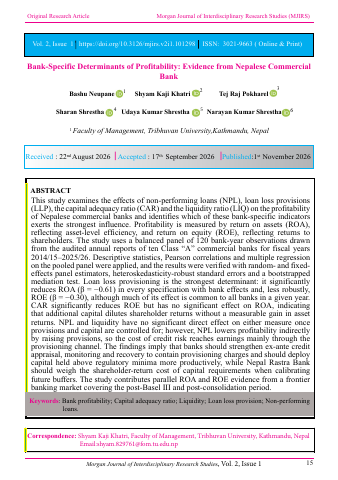
- The study uses a balanced panel of 120 bank-year observations from ten Class "A" commercial banks for fiscal years 2014/15–2025/26.p.1
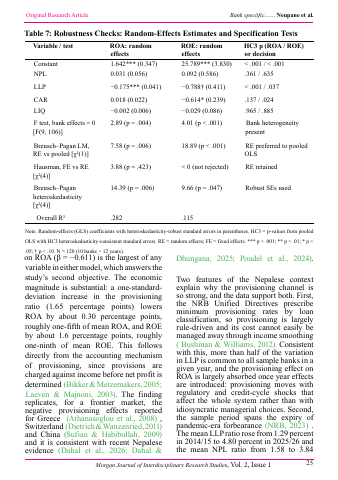
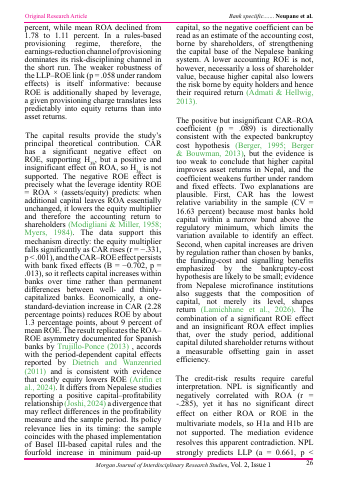
- Loan loss provisioning is the strongest determinant of profitability, reducing ROA (β = -0.61) and, less robustly, ROE (β = -0.30).p.1
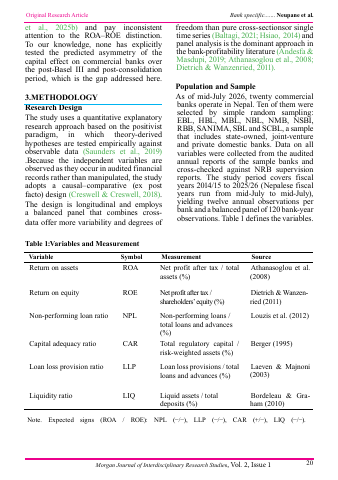
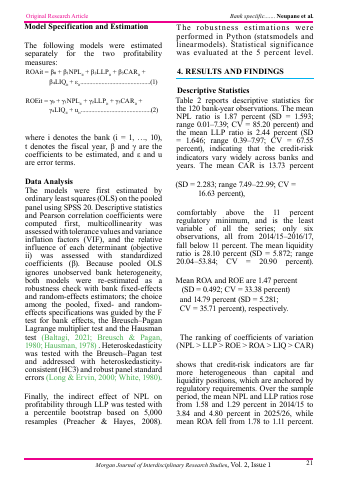
- Mean ratios are 1.87 percent for NPL, 2.44 percent for loan loss provisions and 13.73 percent for capital adequacy.p.7
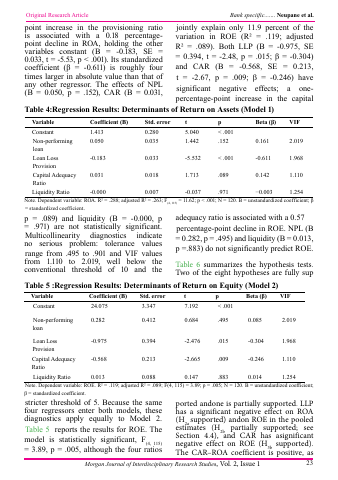
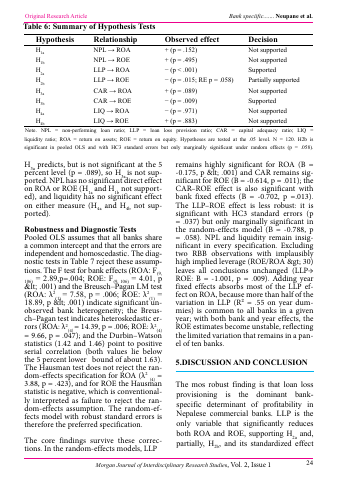
- A one-percentage-point increase in the capital adequacy ratio is associated with a 0.57 percentage-point decline in ROE.p.9
- Mean ROA declined from 1.78 to 1.11 percent over the period.p.12
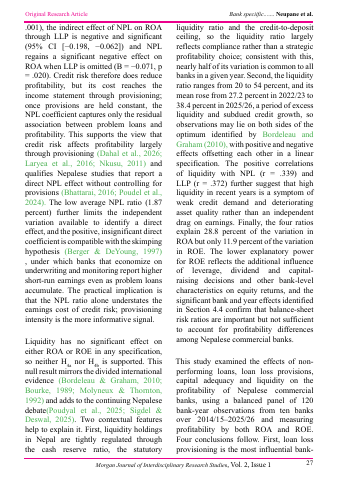
- The mean liquidity ratio rose from 27.2 percent in 2022/23 to 38.4 percent in 2025/26.p.13
Key insights
- A one-percentage-point increase in the provisioning ratio is associated with a 0.18 percentage-point decline in ROA.p.9
- A one-standard-deviation increase in provisions (1.65 percentage points) lowers ROA by about 0.30 percentage points.p.11
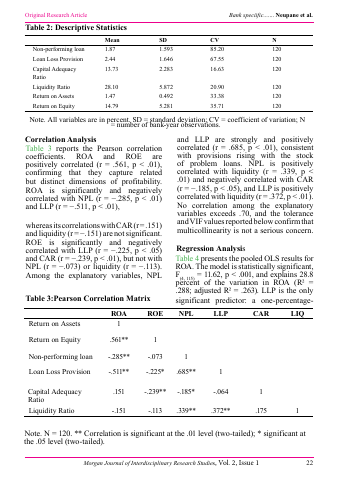
- The four bank-specific ratios explain 28.8 percent of the variation in ROA.p.8
- NPL and loan loss provisions are strongly and positively correlated (r = .685).p.8
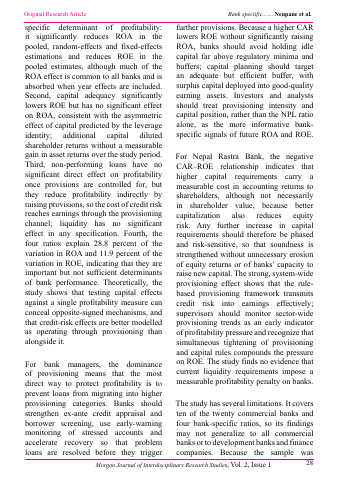
- Capital adequacy has a negative significant effect on ROE but no significant effect on ROA, consistent with the leverage identity.p.12
- The low average NPL ratio of 1.87 percent limits the independent variation available to identify a direct effect on profitability.p.13
- Capital adequacy is comfortably above the 11 percent regulatory minimum, with only six observations below it.p.7
Pages
 p.1
 p.2
 p.3
 p.4
 p.5
 p.6
 p.7
 p.8
 p.9
 p.10
 p.11
 p.12
 p.13
 p.14
 p.15
 p.16
 p.17
 p.18
 p.19
Topics and entities
Summary and figures generated from the document and checked automatically: every number shown appears on the cited page. Publishers can request removal.