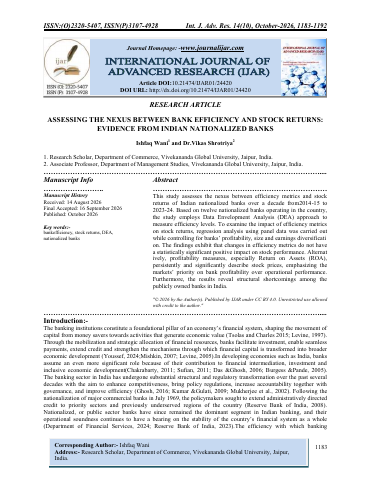
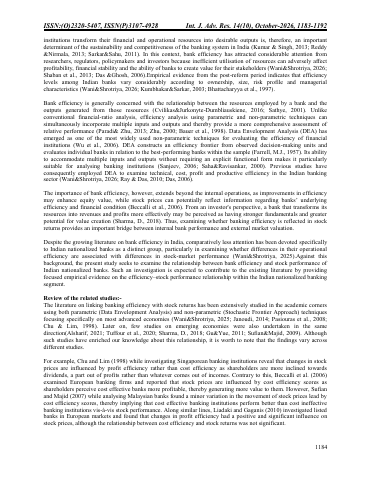
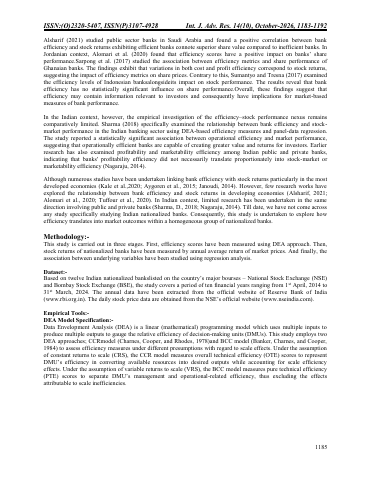
Assessing the Nexus Between Bank Efficiency and Stock Returns: Evidence from Indian Nationalized Banks (International Journal of Advanced Research)
Summary
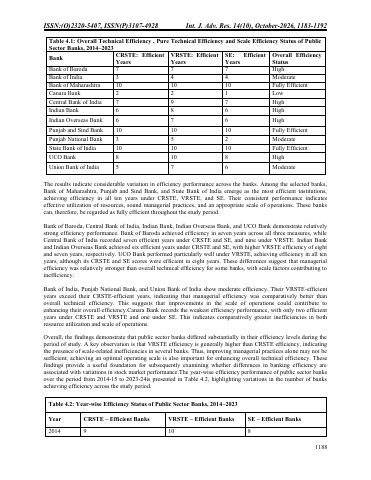
- Three banks—Bank of Maharashtra, Punjab and Sind Bank, and State Bank of India—achieved full efficiency across all 10 years under CRSTE, VRSTE, and SE metrics.p.6
- Canara Bank recorded the weakest operational performance, achieving efficiency in only 2 years under CRSTE and VRSTE, and 1 year under SE.p.6
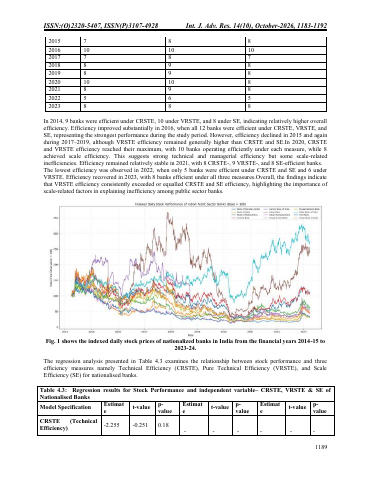
- In 2022, overall efficiency reached its lowest level, with only 5 banks operating efficiently under CRSTE and SE, and 6 under VRSTE.p.7
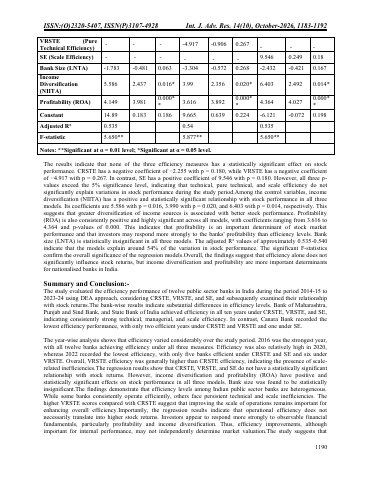
- Regression results show that technical efficiency (CRSTE) has a negative coefficient of -2.255 with a p-value of 0.18, failing to show a statistically significant effect on stock returns.p.8
- Bank profitability measured by Return on Assets (ROA) is highly significant across all regression models with p-values of 0.000, indicating investor focus on profits rather than operational efficiency.p.8
Key insights
- Efficiency metrics derived from Data Envelopment Analysis (DEA) do not exert a statistically significant impact on the stock returns of Indian nationalized banks.p.8
- Return on Assets (ROA) consistently and significantly explains stock prices across all regression specifications with p-values of 0.000.p.8
- Pure technical efficiency (VRSTE) generally exceeds overall technical efficiency (CRSTE), demonstrating that scale inefficiencies drive overall operational drag.p.6
- Bank of Maharashtra, Punjab and Sind Bank, and State Bank of India were the only three public sector banks to achieve full efficiency across all ten sample years.p.6
- The panel regression models explain around 54% of the variance in stock performance, recording adjusted R² values between 0.535 and 0.54.p.8
Pages
 p.1
 p.2
 p.3
 p.4
 p.5
 p.6
 p.7
 p.8
 p.9
 p.10
Topics and entities
Summary and figures generated from the document and checked automatically: every number shown appears on the cited page. Publishers can request removal.