Applications of Markov Chains in Financial Risk Modeling: A Critical Literature Review (Theoretical and Natural Science)
SaveSummary
- In the illustrative baseline scenario, the two-year default probability from a good rating is 2.24%.p.5
- The corresponding adverse-scenario two-year default probability is 6.72%.p.5
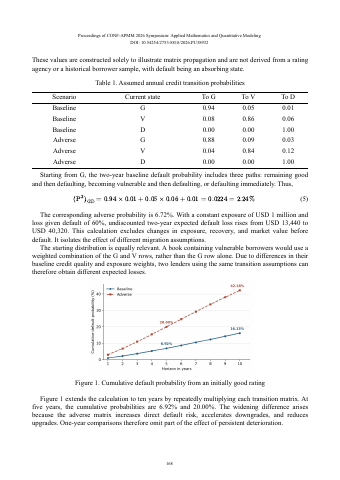
- At five years, the cumulative default probabilities are 6.92% and 20.00%.p.5
- With USD 1 million exposure and 60% loss given default, undiscounted two-year expected default loss rises from USD 13,440 to USD 40,320.p.5
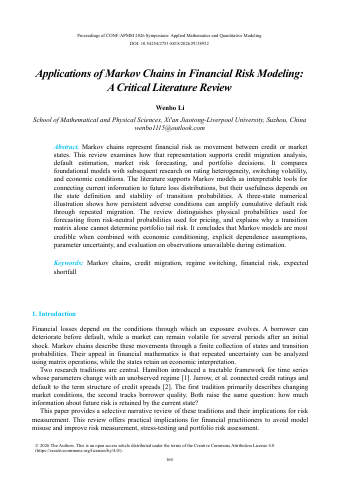
- The review concludes that Markov models are most credible when combined with economic conditioning, explicit dependence assumptions and out-of-sample evaluation.p.1
- The numerical values are constructed for illustration and are not derived from a rating agency or historical borrower sample.p.5
Key insights
- A transition matrix alone cannot determine portfolio tail risk.p.1
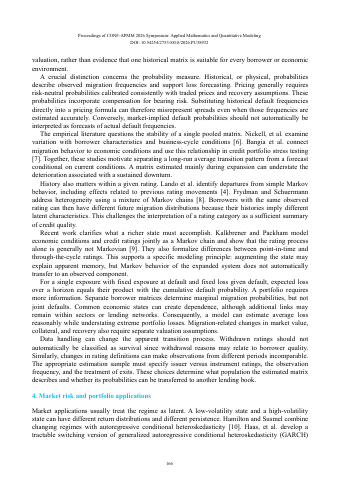
- Physical probabilities support loss forecasting, while pricing requires risk-neutral probabilities.p.3
- A matrix estimated mainly during expansion can understate the deterioration associated with a sustained downturn.p.3
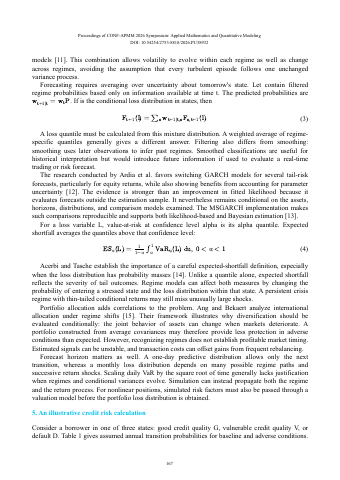
- A loss quantile must be calculated from the mixture distribution, not as a weighted average of regime-specific quantiles.p.4
- Plotted cumulative default probabilities should not be added across years, because that would count earlier defaults repeatedly.p.6
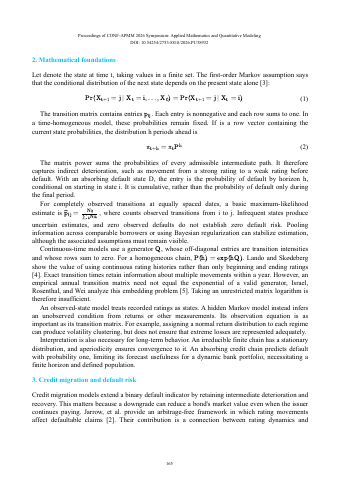
- Zero observed defaults do not establish zero default risk.p.2
- Two lenders using the same transition assumptions can obtain different expected losses because of different starting distributions.p.5
Pages
 p.1
 p.2
 p.3
 p.4
 p.5
 p.6
 p.7
Topics and entities
Summary and figures generated from the document and checked automatically: every number shown appears on the cited page. Publishers can request removal.