Analysis of the Influence of Non-Performing Loans and Capital Adequacy Ratio on Banking Systemic Risk (Jurnal Akuntansi Dan Bisnis Indonesia (JABISI))
SaveSummary
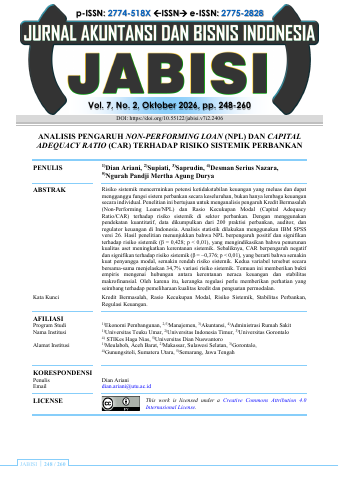
- Data were collected from 200 banking practitioners, auditors and financial regulators in Indonesia and analysed with IBM SPSS version 26.p.1
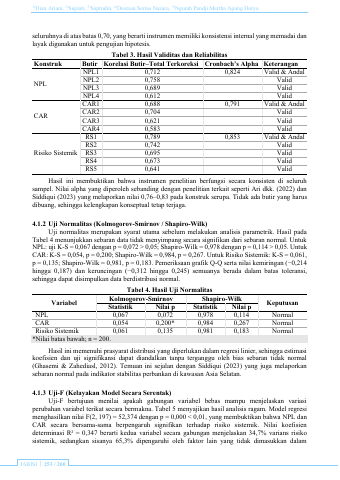
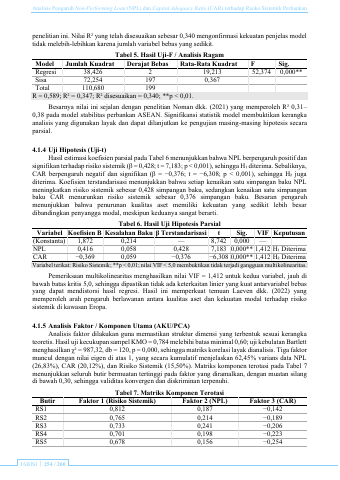
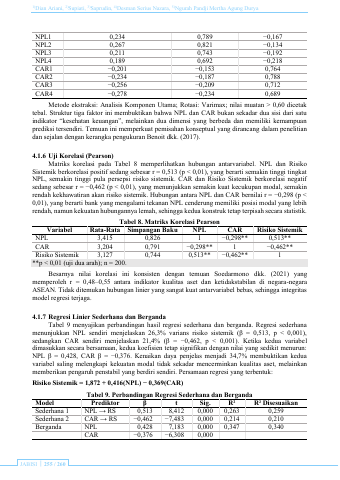
- NPL has a positive significant effect on systemic risk (β = 0.428), while CAR has a negative significant effect (β = -0.376).p.1
- The two variables together explain 34.7% of the variation in systemic risk.p.1
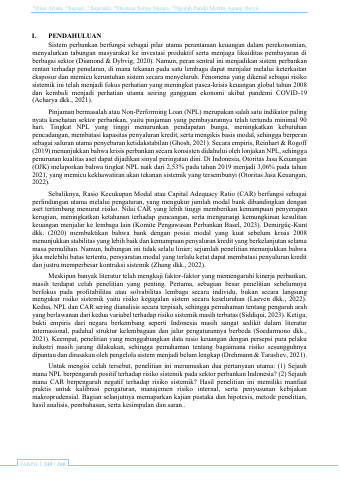
- Indonesia's NPL level rose from 2.53% in 2019 to 3.06% in 2021, according to OJK.p.2
- NPL and systemic risk correlate at r = 0.513, CAR and systemic risk at r = -0.462, and NPL and CAR at r = -0.298.p.8
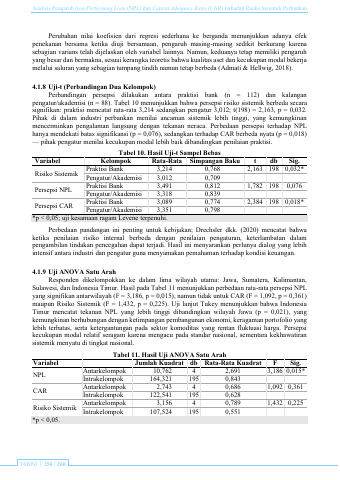
- Bank practitioners (n = 112) rate systemic risk higher, with a mean of 3.214, than regulators and academics (n = 88), at 3.012.p.9
Key insights
- Non-performing loans are defined as loans whose payments have been delayed by at least 90 days.p.2
- The NPL effect on systemic risk has a t value of 7.183, and the CAR effect a t value of -6.308.p.7
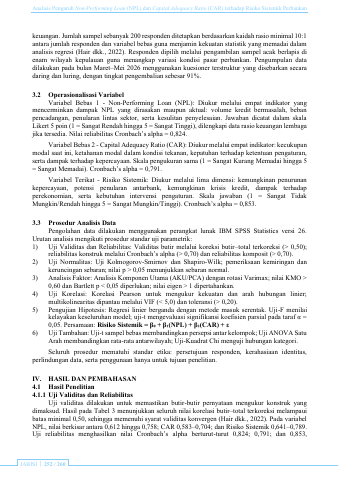
- Data collection ran from March to May 2026 with a return rate of 91%.p.5
- Cronbach's alpha is 0.824 for NPL, 0.791 for CAR and 0.853 for systemic risk.p.5
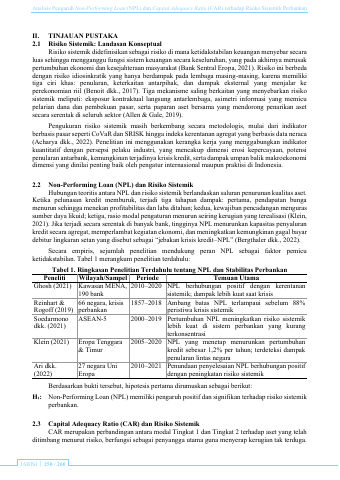
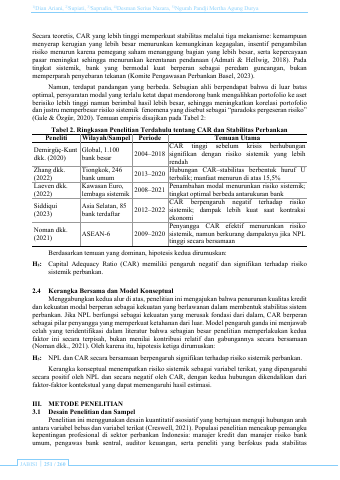
- Prior research on China found the benefit of higher CAR declines above 15.5%.p.4
- Perception of CAR differs significantly between practitioners and regulators (p = 0.018).p.9
Pages
 p.1
 p.2
 p.3
 p.4
 p.5
 p.6
 p.7
 p.8
 p.9
 p.10
 p.11
 p.12
 p.13
Topics and entities
Summary and figures generated from the document and checked automatically: every number shown appears on the cited page. Publishers can request removal.