Analysis of the Effect of Capital Adequacy Ratio and Non-Performing Loans on Firm Value: A Study on Himbara Banks (2016-2025) (Jurnal EMT KITA)
SaveSummary
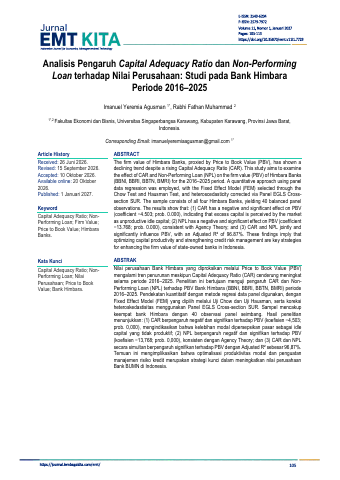
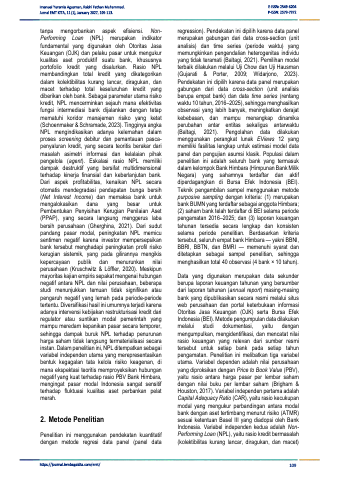
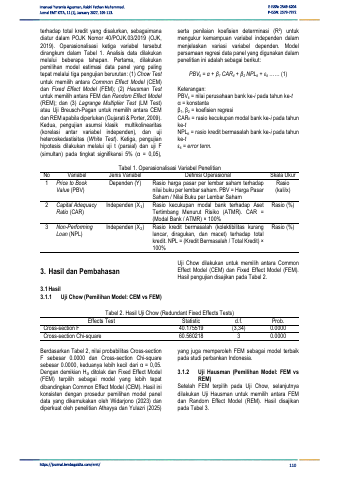
- The study covers four Himbara banks (BBNI, BBRI, BBTN, BMRI) over 2016–2025, giving 40 balanced panel observations.p.1
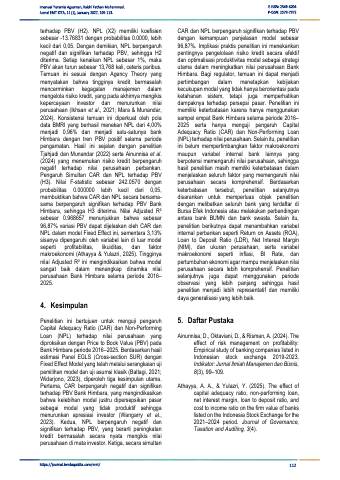
- CAR has a negative and significant effect on PBV, with a coefficient of −4.503 and prob. 0.000.p.1
- NPL has a negative and significant effect on PBV, with a coefficient of −13.768 and prob. 0.000.p.1
- CAR and NPL jointly explain PBV with an Adjusted R² of 96.87%.p.1
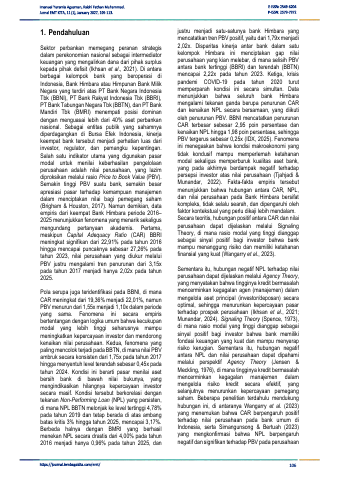
- Himbara banks hold more than 40% of national banking assets.p.2
- BMRI cut its NPL from 4.00% to 0.96% and was the only Himbara bank with a positive PBV trend.p.8
Key insights
- Firm value of Himbara banks, proxied by PBV, declined despite a rising capital adequacy ratio.p.1
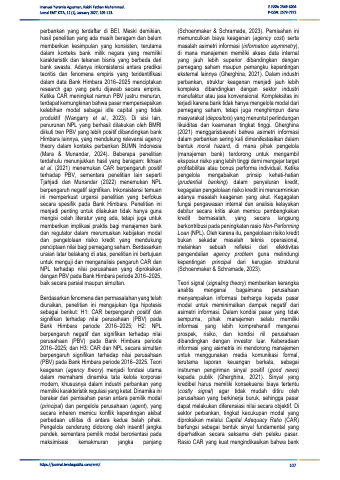
- Excess capital is perceived by the market as unproductive idle capital, consistent with the negative CAR effect.p.1
- The PBV gap between the highest (BBRI) and lowest (BBTN) bank reached 2.22x in 2023.p.2
- BBNI saw CAR fall by 2.95 percentage points and NPL rise by 1.98 percentage points, eroding PBV by 0.25x.p.2
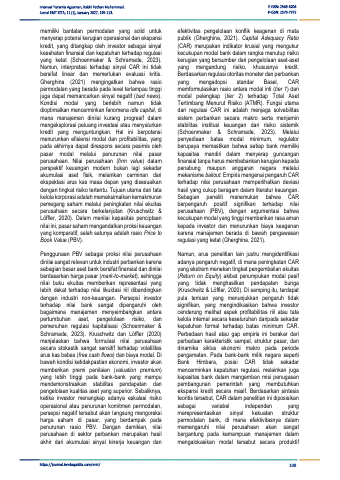
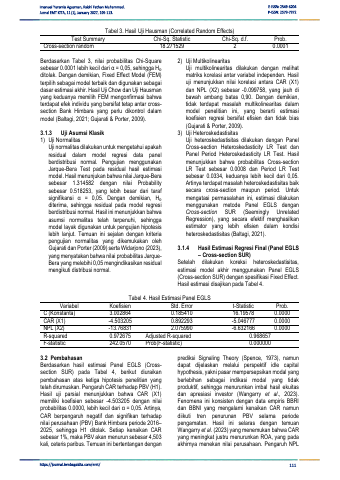
- The Hausman test probability of 0.0001 led to selection of the Fixed Effect Model.p.7
- The correlation between CAR and NPL is -0.099758, indicating no multicollinearity problem.p.7
- Optimizing capital productivity and strengthening credit risk management are the main strategies to raise firm value.p.8
Pages
 p.1
 p.2
 p.3
 p.4
 p.5
 p.6
 p.7
 p.8
 p.9
Topics and entities
Summary and figures generated from the document and checked automatically: every number shown appears on the cited page. Publishers can request removal.